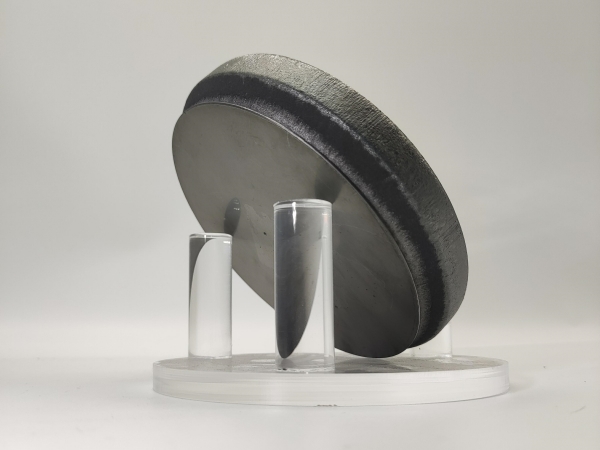
Sapphire (α-Al₂O₃) belongs to the hexagonal crystal system, with several common orientations:
C-plane (0001): Polar plane, widely used in GaN epitaxy.
A-plane (11-20): Non-polar plane, reduces polarization effects.
M-plane (10-10): Non-polar plane, surface normal perpendicular to the a-axis.
R-plane (1-102): Semi-polar plane, approximately 57.6° to the c-axis.
The M-plane sapphire has a surface normal along the (10-10) crystallographic plane. It is considered a non-polar orientation, meaning that epitaxial GaN grown on M-plane sapphire does not experience the strong polarization fields present in C-plane GaN, effectively eliminating the quantum-confined Stark effect (QCSE) in quantum wells.
Surface plane: (10-10)
Orientation type: Non-polar
C-axis tilt: GaN c-axis lies in-plane, perpendicular to the growth surface
Lattice mismatch: ~13–16% with GaN, requiring careful defect control during epitaxy
Key feature: The non-polar nature allows for quantum wells without polarization-induced electric fields, which is critical for improving LED efficiency and emission uniformity.
Lattice constants: a ≈ 4.758 Å, c ≈ 12.991 Å (α-Al₂O₃)
Hardness: Mohs hardness 9, highly durable
Thermal expansion coefficient: anisotropic, ~5–8 ×10⁻⁶ /K
Optical transparency: 200 nm – 5 μm
Thermal conductivity: 25–35 W/m·K
These properties make M-plane sapphire stable under high-temperature and high-stress growth conditions and suitable for high-quality GaN epitaxy.
Non-polar orientation: Eliminates polarization-induced electric fields in quantum wells, mitigating QCSE and enhancing LED and laser performance.
Improved emission efficiency: Particularly beneficial for green and blue LEDs where C-plane devices suffer from QCSE.
Directional anisotropy control: Thermal and optical properties are in-plane dependent, which can be leveraged in device design and waveguide applications.
High-performance LEDs: Non-polar GaN LEDs with higher efficiency and uniform emission
Laser diodes: Non-polar quantum wells reduce QCSE, improving output power and wavelength stability
Power electronics: Non-polar GaN is suitable for high-frequency, high-power applications
Optoelectronics and photonics: UV photodetectors, waveguides, and micro-LEDs
Research purposes: Investigation of non-polar GaN epitaxy and defect formation mechanisms
Defect density: High density of dislocations and stacking faults in M-plane GaN requires optimized growth techniques.
Wafer size and cost: M-plane substrates are more difficult to cut and polish than C-plane, limiting large-scale production
Stress management: Anisotropic thermal expansion can cause wafer bowing and cracking during epitaxy
Industrial maturity: Process know-how and supply chains are less developed than for C-plane sapphire
Next-generation LEDs: Green, blue, and UV LEDs with enhanced efficiency due to non-polar quantum wells
Advanced laser diodes: For displays, communication, and UV photonics
Novel epitaxial techniques: ELOG, nanopatterned substrates, and stress management strategies to reduce defects
Material competition: Development of freestanding GaN and SiC substrates will drive further improvements in M-plane sapphire quality and scalability
Summary:
M-plane sapphire, with its non-polar orientation, provides a platform for high-efficiency GaN-based LEDs and laser diodes. While challenges remain in defect control, wafer size, and cost, its ability to eliminate polarization-induced electric fields makes it a critical substrate choice for next-generation optoelectronic devices.

JXT Technology Co., Ltd. supplies high-quality 2–12 inch sapphire substrates, including special-orientation wafers such as M-plane, A-plane, R-plane, and C-plane. The company also offers PSS (Patterned Sapphire Substrates) and NPSS (Nano-Patterned Sapphire Substrates) with custom designs and mass-production capability, providing reliable solutions for optoelectronics, power devices, and advanced packaging applications.
1. Technical OverviewSingle-crystal diamond substrate wafers feature grain-boundary-free...
1. Technical OverviewFeaturing superior comprehensive physical and chemical properties, ...
With the continuous upgrading of high-power continuous-wave lasers, pulsed lasers, and h...